

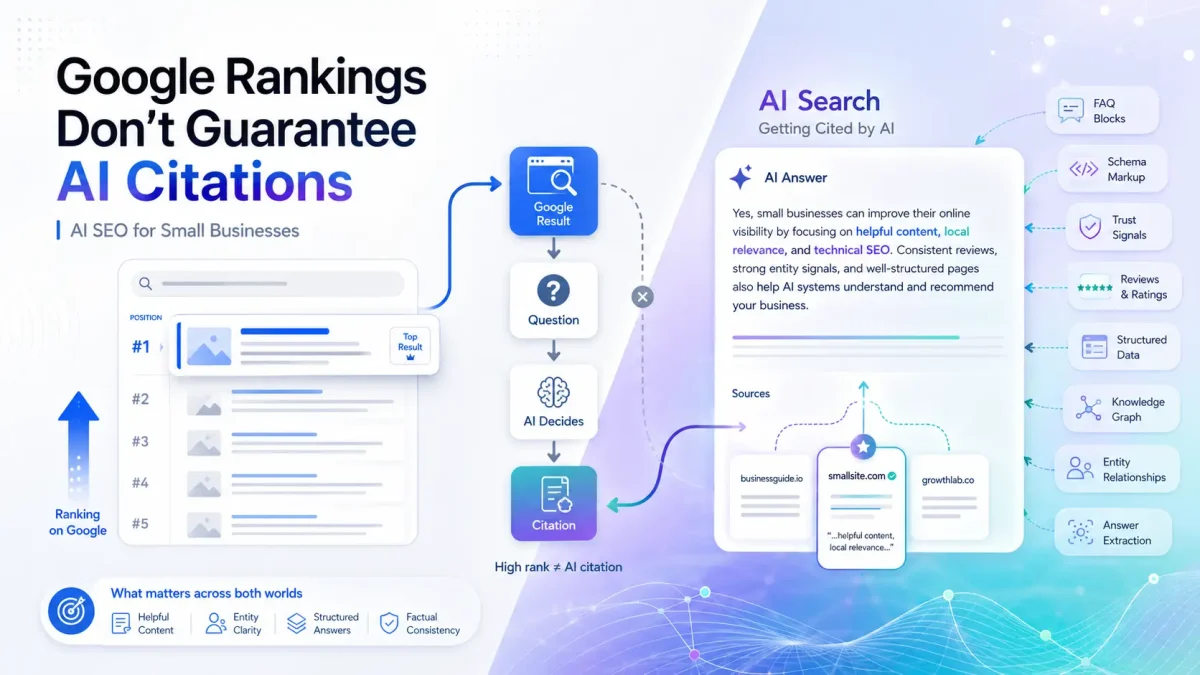
Quick answer: AI SEO for a small site means 3 things done together. Structure content to answer questions directly (see how small businesses are already using AI day to day for the broader context). Build real trust signals like reviews and third-party mentions. Keep your site technically readable by AI crawlers. Doing only 1 of these gets you fewer AI citations than a competitor doing all 3, even if you outrank them on Google.
Key Takeaways
- AI SEO sits on top of traditional SEO. It does not replace it. You need both.
- Pages that lead with a direct answer in the first 2 sentences get cited more than pages that bury the answer in paragraph 6, even when the buried version ranks higher on Google.
- Google Business Profile completeness and review depth (not just review count) are now measurable AI-visibility levers for local businesses, not just Maps-ranking levers.
- AI content detectors do not reflect how search engines or AI models actually judge content. Specificity and verified facts matter more than “AI-written” scores.
- Realistic timeline: 2-6 weeks for technical fixes, 4-12 weeks for content restructuring, 3-6+ months for authority signals to compound.
What Is AI SEO and How Is It Different From Traditional SEO?
AI SEO is the practice of structuring a website so AI answer engines can extract and cite it, not just so Google ranks it. It sits alongside 3 related disciplines: AEO, GEO, and LLMO, and for a small site you work on the first 3 together.
1. AI SEO vs. Traditional SEO vs. AEO vs. GEO
| Term | Optimizes For | Where You See Results |
| SEO | Ranking in blue-link results | Google, Bing organic results |
| AEO | Being the direct answer to 1 specific question | Featured snippets, voice search, AI Overviews |
| GEO | Being cited inside a generated AI answer | ChatGPT Search, Perplexity, Copilot |
| LLMO | Being trusted source data inside a model | Long-term brand recognition, mostly indirect |
2. Live Search-Demand Data We Pulled for This Piece (2026-07-17)
Most “AI SEO” content quotes generic advice without ever checking whether the term itself has real search demand. We pulled this directly from Semrush’s US database while writing this piece, not from a template:
| Keyword | Search Volume | CPC | Competition |
| ai search engine optimization | 4,400/mo | $16.03 | 0.41 |
| ai seo services | 3,600/mo | $24.38 | 0.14 |
| ai seo agency | 2,900/mo | $23.30 | 0.11 |
| ai seo for small business | 10/mo | $20.04 | 0.71 |
| seo (plain) | 2,240,000/mo | $6.45 | 0.20 |
Our read on this data: the bare phrase “ai seo for small business” gets almost no direct search volume, yet its CPC ($20.04) sits far above plain “seo” ($6.45) and close to “ai seo agency” ($23.30). That combination, high commercial value with almost no search volume, is the signature of a phrase advertisers are betting will grow, not one person are already searching in volume.
Write for the underlying questions people actually type, like “how much does seo cost for small business” (590/mo), not the industry-jargon phrase itself. Chasing the jargon phrase directly is a wasted rewrite.
3. Why “Ranking Well” and “Getting Cited by AI” Are Not the Same Goal
Google’s classic ranking rewards topical relevance, backlinks, and accumulated trust. AI answer generation rewards the single passage that most directly and confidently answers 1 specific question.
A page can sit on page 1 of Google and never once get pulled into a ChatGPT or Perplexity answer, because the 2 systems score entirely different things.
4. The Two Ways People Actually Use AI Tools, and Why It Changes What Gets Cited
Most AI SEO advice treats “showing up in AI answers” as 1 goal. It is actually 2, and they pull in different directions.
- AI as a suggestion tool: the user asks the model to analyze options and recommend 1 winner (“best CRM for a 5-person team”). The model synthesizes across sources and rarely names a single URL.
- AI as an informative source: the user asks a factual or how-to question (“how do I set up a Google Business Profile”). The model is far more likely to lift and cite a specific passage.
Content written for the second use case gets cited far more often than content written for the first, because there is an actual passage to extract.
If your page reads like a marketing copy trying to win a comparison, it is optimized for a mode that rarely produces a citation at all.
OpenAI’s own move to build a dedicated AI-native search product is a signal that the “informative source” use case is the one search companies are racing to own, not the recommendation-engine use case.
Why Ranking Well on Google No Longer Guarantees AI Visibility
A page ranking #1 on Google can still be invisible to AI tools if the answer is buried past the first few sentences.
AI systems extract the fastest, most confident answer available, not the most comprehensive one.
A tight 500-word section regularly beats a thorough 2,000-word article that takes 6 paragraphs to make its point.
1. Where This Gap Shows Up Hardest: Local Business Visibility
A business can rank in the top 3 on Google Maps, with strong reviews and a claimed profile, and still not appear when someone asks ChatGPT or Perplexity for “the best [service] near me.”
- Maps ranking rewards: proximity, category match, review volume.
- AI answer citation rewards: structured data, cross-site consistency, and how directly the business’s own content answers the exact question asked.
Semrush question data confirms this split is a live search behavior, not a hypothetical. “Does ai help with local seo for small businesses” is an actual tracked US query.
2. The 3 Signals AI Systems Check That Google Ranking Doesn’t Directly Reward
- Extraction speed: can the answer be lifted from the first 2-3 sentences of a section without reading the whole page
- Cross-site consistency: does the same fact (name, price, claim, service) appear identically across your site and independent third-party sources
- Structured clarity: does the page use schema, tables, and headings that remove ambiguity about what each section represents
3. Is SEO Still Worth It for a Small Business in the AI Search Era?
Yes. AI answer engines still draw their source material from the same crawled, indexed, backlinked web that traditional SEO builds. Skipping SEO to chase “AI visibility” removes you from the pool AI systems select from in the first place.
The Intent Coverage Framework: Structuring Content AI Can Actually Cite
Before rewriting anything, map the layered questions behind your topic instead of the bare keyword. Most content answers only 1 layer.
AI systems reward pages covering at least 2 adjacent layers in a single place, because that reduces how many sources the AI has to combine to answer a follow-up.
1. The 4 Question Layers Behind Every AI SEO Topic
- Definition layer: “What is AI SEO?” (someone hearing the term for the first time)
- Comparison layer: “AI SEO vs. traditional SEO” or “is it worth it for a small business?”
- Implementation layer: “How do I actually restructure my content?” (steps, tools, cost)
- Troubleshooting layer: “Why does my page rank on Google but never get cited by ChatGPT?”
A page answering only layer 1 or layer 3 is common and forgettable. A page answering layer 1 and layer 4 together, in 1 place, is rare and citable, because it resolves a real confusion instead of just defining a term.
2. Triage Your Questions by Intent Before You Restructure Anything
Search-term reports get analyzed by intent bucket (cold, brand, competitor, transactional) before anyone acts on them.
Content briefs almost never get the same treatment, and it shows.
- Sort every question you plan to answer into 1 of the 4 layers above.
- Never blend 2 layers inside 1 paragraph. A comparison answer buried inside a definition paragraph gets extracted badly by both humans and AI systems.
- Write the layer-1 and layer-4 pairing first. It is the rarest combination on the page 1 results for most small-business topics.
3. How to Apply This to a Page You Already Have
Take your highest-traffic existing post and list its layer-1 through layer-4 questions before touching a word of the draft. If 2 layers are missing, that is your rewrite brief.
How to Restructure Existing Content for AI Citation, Step by Step
This 6-step process applies to any page you already have. Start with your highest-intent pages, not your whole site at once.
Steps 1 Through 3: Lead, Reframe, Compare
- Lead with the answer. The first 2 sentences after any heading must directly answer the question the heading poses.
- Turn headings into real questions. “Pricing” becomes “How much does AI SEO cost for a small business?”
- Add a comparison table wherever a choice exists. If a sentence would otherwise say “it depends,” that logic belongs in a table.
Steps 4 Through 6: Commit, Mark Up, Refresh
- State an explicit recommendation. “For a blog under 50 posts, do X first. For a service business with 5+ locations, do Y first.”
- Add a schema that matches the content type. FAQ, HowTo, and Article schema remove ambiguity about what each section represents.
- Keep the update visible. Refresh the published date and at least 1 section whenever you materially update a page.
Worked example, before and after:
- Before: H1 is “SEO Tips for Small Businesses.” No direct answer in the intro. No comparison table. No FAQ schema.
- After: H1 becomes “How Should a Small Business Approach SEO in 2026?” A 2-sentence direct answer opens the page. A “DIY vs. Agency vs. AI Tools” comparison table is added. FAQ schema covers the 5 most common follow-up questions.
- Result: word count barely changes. Citation-worthiness does.
AI SEO for Local and Small Businesses: GBP, Reviews, and Trust Signals
For a business with a physical location or service area, AI visibility depends heavily on data outside your blog entirely.
Your Google Business Profile, your review footprint, and how consistently your facts appear across the web carry more weight than most owners assume.
Google Business Profile Checklist for AI Visibility
- All categories, services, hours, and photos filled in completely, not just the minimum fields
- Name, address, and phone number identical across your website, GBP, and top 10 directories
- 15+ detailed reviews mentioning specific services, spread across 2+ platforms, not just Google
- LocalBusiness schema implemented site-wide, not just on the contact page
- At least 1 mention on a local news, association, or industry directory site
Why Review Depth Matters More Than Review Count
A business with 100+ recent, detailed reviews naming specific services tends to be treated as more trustworthy than one with a larger but generic, single-platform count. The signal being read is specificity and independence, not raw volume.
- Count signal (weaker on its own): total number of stars, 1 platform.
- Depth signal (what AI systems weigh more): specific services named, recent dates, spread across 2+ independent platforms.
Third-party mentions work the same way. Local news, chamber of commerce pages, and industry directories corroborate a claim your own website makes, and AI systems weight corroborated claims more heavily than self-reported ones.
That logic extends beyond local business too, into how AI is reshaping personalization across marketing generally, where trust compounds across channels rather than sitting in just 1.
Does AI-Assisted Content Hurt Rankings? The Content Quality Pyramid
No, not inherently. Search engines have stated they do not penalize content for being AI-assisted specifically.
What gets deprioritized is low-value content, regardless of who or what produced it.
The real confusion comes from AI detection tools. They are unreliable by design, since they are built on models trained on human writing and cannot consistently separate “AI-written” from “formally structured human writing.”
1. Our Take: Why “GEO” Isn’t Really a New Discipline
Most AI SEO content treats GEO as a bolt-on skill you add to your existing SEO work. It isn’t.
It is the same trust-and-clarity work good SEO always requires, just judged faster and more literally, because an AI system has seconds to decide what to extract instead of a human skimming for a minute.
2. Why AI Detectors Are Not a Reliable Signal to Optimize Against
Detector scores frequently flag human-written text as AI-generated, and just as often miss AI-assisted text that has been edited with specific data added.
Optimizing to “beat a detector” targets the wrong problem entirely.
The bigger, more legitimate risk sits elsewhere. Generative AI’s own tendency to make factual mistakes means every
AI-assisted draft still needs a human fact-check pass before publishing, regardless of what a detector says about it.
3. The Content Quality Pyramid: 3 Layers, Bottom to Top
- Accurate, structured baseline information: correct but interchangeable with a thousand other pages saying the same thing.
- Specific examples: real numbers, named tools, named sources instead of vague claims.
- Original insight: a tested claim, a stated recommendation, a point of view a generic prompt would not produce on its own.
If a paragraph can be deleted without the piece losing anything, delete it. That single edit raises a piece’s position on this pyramid faster than adding more words does.
How to Measure, Maintain, and Budget for AI Search Visibility
Traditional rank tracking does not capture AI visibility. It needs a second, parallel habit, run monthly, not checked once and forgotten.
1. The Direct-Prompt Test
Run the 10-15 real questions your customers ask through 3 tools every month:
- ChatGPT, with search enabled
- Perplexity
- Google’s AI Mode
For each answer, log 3 things: is your site mentioned, is a competitor cited instead, and which specific source won.
Google’s own shift toward AI-generated answers makes this test more relevant every quarter, not less.
2. Signals Worth Tracking Beyond Rank Position
Treat this the same way you’d treat deeper consumer-insight research: the goal is understanding real behavior, not just watching a rank tracker move.
| Signal | Where to Check | What It Tells You |
| Long-tail queries (30+ characters) | Google Search Console | Real questions already reaching your site, close to AI prompt phrasing |
| Referral traffic from AI platforms | Analytics referral sources (chat.openai.com, perplexity.ai) | Actual AI-driven visits, small in volume but directionally useful |
| Citation presence in direct-prompt tests | Manual monthly log | The single most reliable signal for whether structural changes are working |
3. Common Mistakes That Undo Good Work
| Mistake | Why It Fails | Fix |
| Optimizing only the homepage | AI answers cite specific passages, not homepages | Restructure your highest-intent individual posts first |
| Adding FAQ schema without matching content | Schema without a real answer underneath can hurt more than help | Write the direct answer first, mark it up second |
| Chasing AI SEO jargon keywords with near-zero volume | “ai seo for small business” tracks only 10 monthly searches despite $20.04 CPC | Target the underlying question set, not the bare industry phrase |
| Rewriting a page that already ranks #1-3 | Risks losing a position Google already validated | Make minor factual and freshness updates only |
| Trusting a vendor’s “get ranked on ChatGPT” pitch at face value | Many AI-visibility vendors sell the same generic promise with no proof | Ask for a before/after direct-prompt test result, not a demo |
4. Realistic Cost and Timeline
- Technical fixes (schema, GBP completeness, NAP consistency): 2-6 weeks to show effects.
- Content restructuring for AI citation: 4-12 weeks, since it depends on AI systems re-crawling and re-scoring your pages.
- Authority signals (reviews, third-party mentions, topical clusters): 3-6+ months, compounding rather than one-time.
None of these can be shortcut by a single tool purchase.
FAQs
1. Does AI SEO replace traditional SEO?
No. AI answer engines still rely on the crawled, indexed, backlinked web for source material. Traditional SEO gets you into the pool of candidates; AI-specific structuring determines whether you get selected from that pool.
2. Will using AI to write my content hurt my SEO?
Not inherently. Content gets deprioritized for being generic and low-value, not for being AI-assisted. Edit in specific examples, real numbers, and a clear recommendation before publishing.
3. How much does AI SEO cost for a small business?
There is no fixed price. The highest-leverage actions (GBP optimization, restructuring 3 existing posts) are largely time investment, not spend. Evaluate any paid vendor by proof, not promises.
4. Does AI help with local SEO for small businesses?
Yes, but through a different signal set than Maps ranking. AI answer engines weigh structured data, review depth, and cross-site consistency more heavily than proximity alone.
5. Is SEO still worth it for a small business in 2026?
Yes. It remains the foundation AI visibility is built on top of, not a separate or declining channel.
6. How long does AI SEO take to show results?
Technical fixes: 2-6 weeks. Content restructuring: 4-12 weeks. Authority and entity signals: 3-6+ months, compounding rather than one-time.
Conclusion: Your Next 30 Days
Start with 1 page, not your whole site.
- Pick your highest-traffic existing post.
- Run it through the Intent Coverage Framework and note which of the 4 layers are missing.
- Apply the 6-step restructuring process.
- Run the direct-prompt test against it before and after.
That single before/after comparison will tell you more about what moves AI citations for your specific site than any generic checklist, including this one.
Einfo.ai tracks these shifts daily, from how AI is changing digital marketing strategy more broadly to what stronger prompting actually looks like once you’re using
AI tools to research and draft this kind of content yourself. Follow along on LinkedIn or keep exploring the AI Tutorials category for the next piece in this series.