
For more than two decades, website owners understood Google Search in a familiar way: users typed a query, Google showed a list of links, and websites competed to earn clicks. In 2026, that pattern is changing. Google Search is no longer only a search results page. It is becoming a place where users can ask longer questions, receive Google AI answer by AI search engine, continue the conversation, compare options, and in some cases ask AI agents to complete tasks.
This does not mean websites are finished. It does mean that the old habit of publishing generic articles and waiting for search traffic is becoming weaker. The websites that survive will be the ones that give Google and readers something AI cannot easily replace: original experience, verified information, expert interpretation, useful examples, and a reason to trust the publisher.
If your website depends on organic traffic, the question is no longer only “How do I rank on Google?” The better question is: “Why should Google, an AI system, and a human reader choose my page as a useful source?”
The short answer: yes, Google AI answer is becoming more answer-driven
Google has been clear that AI is now central to the future of Search. In May 2026, Google announced what it called a new era for AI Search, saying it was bringing advanced model capabilities to Search and enabling people to use agents by asking questions. Google also described a new intelligent AI-powered Search box as its biggest upgrade in over 25 years.
At Google I/O 2026, the company said AI Mode had surpassed more than 1 billion monthly users and that AI Mode queries were more than doubling every quarter. Google also described a more seamless AI Search experience where users can move from a normal question to an AI Overview and then continue into AI Mode with links to learn more.
For website owners, this confirms a major shift: Search is becoming less like a directory of pages and more like an answer system that uses pages, data, context, and AI reasoning to satisfy the user’s intent.
What are AI Overviews and Google AI answer?
AI Overviews are AI-generated summaries that can appear in Google Search when Google believes an AI response will help users understand a topic faster. These summaries can include links to supporting websites.
AI Mode goes further. It supports more exploratory, complex, and conversational searches. Users can ask detailed questions that previously required multiple searches. Google says AI Mode and AI Overviews may use a technique called query fan-out, where the system issues multiple related searches across subtopics and data sources to build a more complete response.
This matters because your page may no longer compete only for one keyword. It may compete as one supporting source inside a larger AI-generated answer. That changes how content should be planned, written, structured, and updated.
Does this mean SEO is dead?
No. SEO is not dead, but it is changing. Google’s own Search Central documentation says the best practices for SEO remain relevant for AI features such as AI Overviews and AI Mode. Google also says there are no special technical requirements to appear in AI Overviews or AI Mode beyond being indexed and eligible to appear in Search with a snippet.
However, “SEO is still relevant” should not be misunderstood. It does not mean that old SEO tricks will continue to work. It means the foundation still matters: crawlability, indexability, page experience, helpful content, internal links, structured data that matches visible content, clear page structure, and user satisfaction.
The difference is that AI Search puts even more pressure on quality. If a page simply repeats what dozens of other websites have already said, Google’s AI systems may not need it. If a page has original data, expert commentary, real examples, or a clear explanation that helps people make decisions, it has a stronger chance of being useful.
Why website owners are worried
The concern is simple: if Google answers more questions directly on the results page, users may click fewer links. This is especially concerning for news websites, blogs, affiliate websites, tutorial sites, and informational publishers that depend heavily on search traffic.
The Guardian reported in January 2026 that media executives surveyed by the Reuters Institute expected search engine referrals to fall significantly over the next three years as AI summaries and chatbots change how people find information. The same report noted that search traffic to news sites had already fallen sharply in one year according to cited industry data.
Reuters also reported in 2025 that independent publishers had filed an EU antitrust complaint related to Google AI Overviews, arguing that AI-generated summaries could harm publisher traffic, readership, and revenue. Google’s position, according to the same Reuters report, was that many claims about traffic are based on incomplete or skewed data and that new AI features can create opportunities for businesses.
Both things can be true at the same time. AI Search can create new discovery opportunities for strong websites, while reducing traffic for pages that only provide basic summaries.
The biggest change: Google may reward sources, not summaries
In the past, many publishers built traffic by summarizing information from other sources. In 2026, that is risky. AI systems are very good at summarizing the internet. If your article only summarizes the obvious, it becomes replaceable.
Google’s guide to optimizing for generative AI Search says website owners should create valuable, non- commodity content. It specifically encourages a unique point of view, first-hand experience, helpful organization, high-quality supporting media, and content that goes beyond common knowledge. Google also warns against creating many pages only to capture every search variation or manipulate AI responses.
For publishers, this means a strong article should not look like it was created only because a keyword existed. It should look like it was created because the reader genuinely needed help understanding a topic.
What kind of content is most at risk?
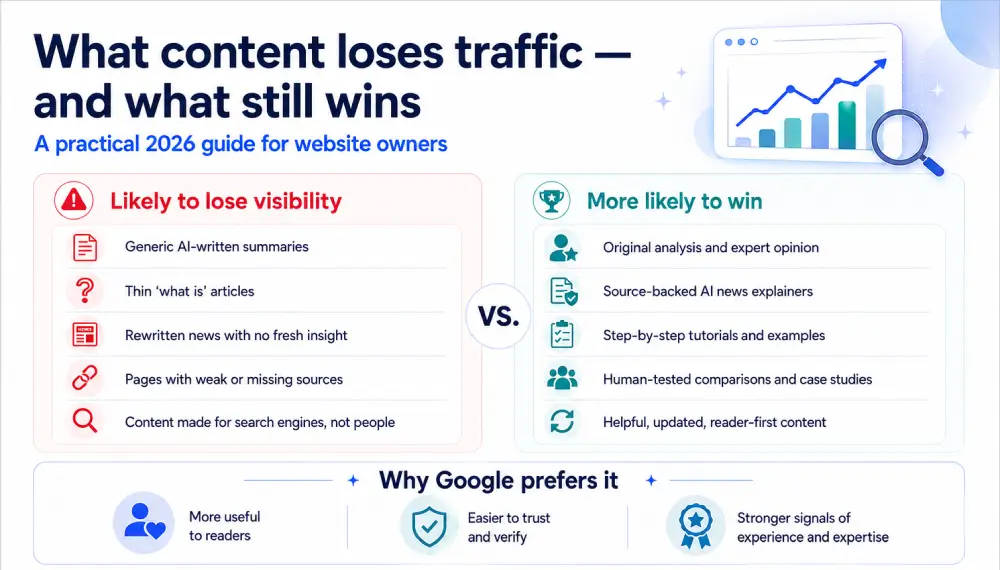
The content most at risk is generic, interchangeable content. This includes basic “what is” articles with no original explanation, AI-written news summaries without sources, listicles that repeat common advice, articles with unsupported claims, and pages created mainly to match keywords rather than solve a real user problem.
For example, an article titled “What Is AI Search?” that gives a basic definition and five generic benefits is unlikely to stand out. But an article that explains how AI Search changes publisher strategy, shows examples, cites Google documentation, includes a practical checklist, and offers a clear editorial perspective is much more useful.
What kind of content can still win in Google AI answer?
The websites that still win organic visibility will usually publish content with one or more of these strengths:
- Original research, data, surveys, screenshots, or testing.
- Clear expert interpretation of complex news.
- First-hand experience from using a tool, product, platform, or workflow.
- Step-by-step tutorials with actual examples, not generic instructions.
- Comparisons that help readers make decisions.
- Timely analysis that cites credible sources and explains what changed.
- Human stories, opinions, and lessons learned from real experience.
This is especially important for AI news websites. AI news is competitive. Many sites publish the same launch summaries. To stand out, an AI news website should explain what the news means, who it affects, what readers should do next, and what risks or opportunities are hidden behind the announcement.
How website owners should adapt in 2026
The first step is to stop thinking of every article as a standalone keyword page. Think of your website as a trusted knowledge source. A strong website has clear topical authority, human authorship, editorial standards, source citations, and internal links that help readers go deeper.
For business websites, this means publishing fewer but stronger articles. For news websites, it means moving beyond simple rewriting. For tutorial websites, it means testing the steps before publishing. For affiliate websites, it means adding real comparisons and user-centered explanations rather than only product roundups.
1. How website owners should adapt in 2026
The first step is to stop thinking of every article as a standalone keyword page. Think of your website as a trusted knowledge source. A strong website has clear topical authority, human authorship, editorial standards, source citations, and internal links that help readers go deeper.
For business websites, this means publishing fewer but stronger articles. For news websites, it means moving beyond simple rewriting. For tutorial websites, it means testing the steps before publishing. For affiliate websites, it means adding real comparisons and user-centered explanations rather than only product roundups.
2. Add credible sources and show where facts come from
For AI news, sources are not optional. If an article discusses Google, OpenAI, Meta, Microsoft, the EU AI Act, model releases, AI safety, traffic loss, or regulation, it should cite official announcements, documentation, reputable journalism, research papers, or recognized institutions. Unsupported claims reduce trust.
3. Add your own analysis
A source-backed summary is good, but it is not enough. Add a section that explains what the development means for website owners, marketers, developers, publishers, or business leaders. This is where your article becomes more valuable than a copied summary.
4. Build topical clusters instead of random posts
If your website covers AI news, create clusters such as AI Search, AI agents, AI regulation, AI tools for business, AI safety, and AI tutorials. Each article should link naturally to related articles. This helps users and search engines understand your site’s expertise.
5. Improve author and editorial trust
Add a real author name, short bio, expertise, editorial review date, and contact or correction policy. Readers should know who wrote the article and why they should trust it. For AI news, an editorial note explaining how sources were checked can improve credibility.
6. Keep important content visible in HTML
Google recommends making important content available in textual form. Avoid hiding key content behind scripts, tabs, images, or unsupported widgets. Use clean headings, paragraphs, lists, and tables where appropriate.
7. Avoid publishing mass Google AI answer content
Using AI tools to assist content creation is not automatically a problem. The problem starts when a site publishes large amounts of low-value, repetitive, or lightly edited AI content. Every article should be reviewed, fact-checked, and improved with human judgment before publishing.
A practical checklist before publishing an AI news article
Before publishing an AI news article in 2026, use this checklist:
- Is the main claim supported by at least one credible source?
- Does the article explain why the news matters?
- Does it add original analysis or practical advice?
- Is the title accurate and not clickbait?
- Are dates, company names, product names, and numbers verified?
- Does the article include internal links to related topics?
- Is there a real author bio or editorial review note?
- Is the article readable on mobile?
- Does the content answer the reader’s question better than competing pages?
- Would you still publish this article if Google traffic did not exist?
How to structure articles for Google AI answer Search visibility
There is no magic format that guarantees inclusion in Google AI answer Overviews or AI Mode. Google says there are no special optimizations required for these features. Still, a clear article structure helps both humans and search systems understand the page.
A strong structure usually includes: a clear headline, a short introduction, direct answer section, background context, explanation of what changed, practical implications, examples, checklist, frequently asked questions, and a source/reference section.
Avoid writing only for snippets. Instead, write so the article is useful from beginning to end. AI systems may extract or cite parts of a page, but real readers still need a complete and satisfying experience.
What this means for small websites
Small websites can still compete, but they cannot compete by copying large publishers. A smaller AI news website should focus on clarity, speed, practical explanation, and niche authority. Instead of covering every AI announcement, choose fewer stories and explain them better.
For example, instead of publishing “Google launches new AI Search features,” a stronger article would be “How Google’s AI Search changes SEO strategy for small business websites.” That angle gives readers practical value and gives the article a clearer reason to exist.
What website owners should not do
Do not create hundreds of pages targeting tiny keyword variations. Do not rewrite press releases without adding value. Do not publish claims without sources. Do not overuse AI-generated images that do not help the reader. Do not add fake author names or fake expertise. Do not depend only on search traffic while ignoring direct audience building.
Google’s own guidance also says website owners do not need special AI files, special markup, or content rewritten only for AI systems to appear in generative AI Search. The focus should remain on useful content and strong technical foundations.
A new SEO mindset for 2026 is Google AI answer
The new SEO mindset is not “How do I trick the algorithm?” It is “How do I become a source worth citing?” That is a much higher standard, but it is also healthier for the web.
In traditional SEO, many teams focused on keywords, word count, backlinks, and publishing frequency. In AI-era SEO, those things may still matter, but they are not enough. The stronger signals are trust, originality, source quality, user satisfaction, and the ability to explain complex topics in a way people actually understand.
Conclusion: websites are not dead, but weak content for Google AI answer:
Google Search is becoming more AI-powered, more conversational, and more answer-driven. Google AI answer engine Overviews, AI Mode, and Search agents are changing how users discover information. This shift may reduce clicks for some websites, especially those that rely on generic informational content. But it also creates an opportunity for websites that publish original, useful, well-sourced, and human-centered content.
The future of website traffic will not belong to the sites that publish the most articles. It will belong to the sites that readers trust, AI systems can understand, and Google can confidently surface as useful sources.
For website owners, the message is clear: stop creating content only to be indexed. Create content that deserves to be referenced.
Recommended FAQ section
Is Google Search becoming an AI answer engine?
Yes. Google Search is increasingly using AI-generated answers, AI Overviews, AI Mode, and agentic features to help users complete more complex searches. Traditional links still matter, but Search is becoming more answer-driven.
Will AI Overviews reduce website traffic?
For some websites, yes. Informational websites and publishers may see fewer clicks when users get answers directly in Search. However, strong websites can still earn visibility when they provide original, reliable, and useful information.
Can small websites still rank in AI Search?
Yes. Small websites can compete by focusing on specific expertise, original examples, source-backed analysis, and helpful explanations instead of publishing generic articles.
Do I need special schema for AI Overviews?
No special schema is required for AI Overviews or AI Mode. Google recommends continuing with normal SEO best practices, technical clarity, helpful content, and structured data that matches visible page content.
Is AI-generated content allowed by Google?
AI-assisted content is not automatically against Google’s rules. The issue is quality. Content should be helpful, accurate, original, reviewed by humans, and created for users rather than only for search rankings.
Sources and references
The article above is written using source-backed information from official Google documentation and reputable media coverage. Add these as external links in the published WordPress article.
- Google Search Central – AI features and your website:
https://developers.google.com/search/docs/appearance/ai-features - Google Search Central – Optimizing your website for generative AI features on Google Search: https://developers.google.com/search/docs/fundamentals/ai-optimization-guide
- Google Blog – A new era for AI Search, May 19, 2026:
https://blog.google/products-and-platforms/products/search/search-io-2026/ - Google Blog – 100 things we announced at I/O 2026:
https://blog.google/innovation-and-ai/technology/ai/google-io-2026-all-our-announcements - Google Blog – I/O 2026: Welcome to the agentic Gemini era:
https://blog.google/innovation-and-ai/sundar-pichai-io-2026/ - The Guardian – Publishers fear AI search summaries and chatbots mean end of traffic era, Jan. 12, 2026: https://www.theguardian.com/media/2026/jan/12/publishers-fear-ai-search-summaries-and- chatbots-mean-end-of-traffic-era
- Reuters – Google AI Overviews hit by EU antitrust complaint from independent publishers, July 4, 2025: https://www.reuters.com/legal/litigation/googles-ai-overviews-hit-by-eu-antitrust-complaint-independent- publishers-2025-07-04/